When I told US friends I was moving to The Dominican Republic, several said they’d vacationed there and loved it. Most, like many of my coworkers and school community, enjoyed seclusion at Punta Cana’s resorts where they received five-star treatment. I get it; I loved this stay at Barcelo Bavaro Grand Resort last fall. Perfection…or at least one version of it. But like my friend from home, Sara, who said she had wanted to see the “real DR,” I also understand why many local friends love the Samana area for adventure and authenticity. I especially like Las Terrenas because of its “mom and pop” properties–private apartments and beach bars I remember from my childhood summers in Florida.
I love the laid back vibe of the province of Samana and will be forever grateful for the good times spent there with friends —horseback riding, swimming in a waterfall, drinking pina coladas on a small island off the main island, and whale watching in Samana Bay. I’ve seen couples enjoying different stages of life together there, too–newlyweds, retirees, and recently a pair from Canada who decided to pack up, move south, start a beach business, and live the dream.
I’ve always been fascinated with expats reinventing their lives in faraway places, like folks I met in Marrakesh like Aussie Alexandra featured on this blog who are doing just that. Likewise, Samana has enticed many from North America and Europe to move to the Caribbean.
Something pulls people here–even if just for a weekend. Anyone who travels regularly from Santo Domingo knows the thrill of coming around this curve, parking on the roadside lookout point, and thinking I’ve arrived. Paradise pops in Renoir-rich blue and green until sunset softens the sky with Monet-muted purples and pinks. This place definitely leaves an impression.
Riding through the province of Samana is also colorful. Mountain homes teeter on cliffs and balance above deep ditches while motorcycles and cars careen around curves.
Last January I loved the villa where my friends were married and vowed to stay in such a place near the hub of town on my next trip. I had instead chosen an all- inclusive in El Portillo because I’d snagged a Daily Deal on Booking.com. I looked forward to pondering possibilities for the new year and not having to decide where to eat or what to cook sounded relaxing.
I left Nashville on a redeye flight after the holidays, had a layover in Miami, then a three-hour bus ride from the Santo Domingo airport. Seventeen hours later, I was excited to finally drop my bag in the room and head for the fridge. I’d planned to grab a beer, order room service, and take a hot bath in the Jacuzzi, but the fridge was empty, room service was not included, and the bath jets were dead. When I went to the terrace to regroup before making the trek back to the front desk, the sliding glass door’s lock fell to the floor. Two days and multiple hikes to the front desk later, I was moved to a room where everything but the safe worked. It was fixed a day later. But on the very bright side–where I like to focus–the weather was perfect, and I loved dancing/exercising at the pool with fun instructors, great music, and guests from Europe. Hearing French, German, Italian, and Spanish on the beach was sweet as was eating every meal on the water, Brazilian steak night, the Crème brûlée, and the French man who sang while couples danced in the dark (see video at bottom).
Winter weather in the DR is amazing. Sunny, mostly dry, breezy and low humidity compared to the rest of the year.
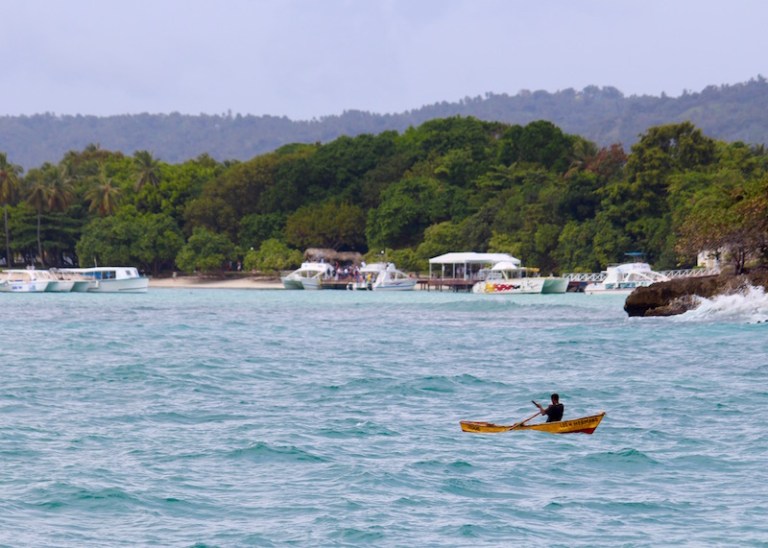
My next trip to Las Terrenas was in mid-March and amazing. Thanks to Sana we had a private villa, Casa Anna, with a pool she found on AirBnB; Italian owners, Allesandra and her husband , greeted us when we arrived. The perfect location, it is in a quiet neighbourhood just a five minute walk to the fisherman’s village, Pueblo de Los Pescadores, the town’s pulse where locals, expats, and tourists shoot pool, watch games, listen to live music, eat, drink and are merry. We started the weekend with dinner there; I had a whole fried fish and a mojito as lights blinked along the shore like fireflies and water lapped the shore near our feet.
Steve and Sana
The next morning we had coffee with the hummingbirds on the bungalow’s covered porch, then went looking for an American-sized breakfast on the beach. We found it at One Love Surf Shack. Owners, Barry and Chef Kari, served bacon, eggs, toast, and rosemary potatoes (delicious). Barry joked if we were looking for granola and yogurt we’d come to the wrong place. I enjoyed every bite but was too full to join the three generations of ladies doing Zumba on the beach beside us. Barry said to come back for Happy Hour, their signature burgers, and open mic night.
Backyard Blooms
Chillin’ with Cava and Fresh-Squeezed Passion Fruit at One Love Barry and Kari, owners of One Love Surf Shack
The Canadian couple scouted locations around the world to open their restaurant: Mexico, Ecuador, Galapagos Islands, France, Thailand, Panama, England, Indonesia, Costa Rica, Malaysia, Singapore, and Hawaii. Why did they choose the DR?
“Health care, title to own the property, exchange rates, tax treaties (getting their retirement money from Canada), basic amenities and infrastructure as opposed to ‘nice to have’ things which we placed on the bottom of the list. We tried to stay away from the ‘la-la’ happy things and focus on daily reality basic fundamentals when making our decision.”
It seems they made a great call… maybe even got it all… judging from the jovial crowd of back-slapping regulars reminiscent of buds who gathered every night at the bar Cheers. We watched the US play the DR in baseball. There was a whole lot of happy going on.
I’ll be leaving the island in June but will maybe return one day with a dance partner like these guys at El Portillo. Sana says she’d like to stay here with Steve and sell coconuts on the beach. No doubt business in Las Terennas will be booming.
Spring break may be in April this year in The Dominican Republic, but spring flings have been happening here for awhile. Every January-March humpback whales go rogue—migrating to Samana from Greenland and Iceland over 3000 miles away. Dr. Ken De Pree, author of Whales of Samana, likens their mating behavior in Dominican waters of Samana Bay, Silver and Navidad Banks to humans cruising singles bars. To attract the ladies, males croon tunes, form bromances to size up the competition, then brawl-it- out with up to nineteen rivals for the most fertile female. Breaching, tail slashing, body slamming each other– sometimes even drawing blood–there’s a whole lot of shakin’ goin’ on. Pregnant moms then carry calves for eleven-twelve months, give birth, and nurse another eleven months until their babies are strong enough to make the journey back to the North Atlantic.
Whale watching ranked top of my DR Bucket List since moving here in 2016. Thanks to my friend, Sana, who booked Kim Beddall, an English- speaking Marine Mammal Specialist with Whale Samana, and her husband, Steve, who booked a car to get us there, we set sail last Sunday on Pura Mia, a 55- foot custom whale watching vessel. We loved returning to beautiful Samana Bay.
Since humpbacks are the most active species of whales anytime, knowing our boat would be a bit bigger than creatures that average 40-50 feet and weigh 30-40 tons (the record is 59 feet and 60 tons) was reassuring. Even so, the traffic of an estimated 1500 whales—400 that congregate at one time in rough waters in Samana Bay– made for some rocking and rolling on the waves. The tour company offers Dramamine, but most, like me, who had never been seasick didn’t take it. A rookie mistake. Thankfully pressure point bracelets, Sprite, and crackers helped as an hour in many of us were turning green.
Steve and Sana
The company offers the next trip free should no whales be spotted, but we, thankfully, hit the motherlode—a 45- foot mom and her 15-foot baby girl that rolled and flailed right beside our boat. Mama Crochet, a regular to these parts named for her lace-like markings, shared her offspring (below) with us up close and personal for much longer than is usual.
Humpbacks are in the family of great whales and are named and catalogued by the unique patterns on their tails, or “flukes,” which power them through the water. These tail markings, like human fingerprints, are one-of-a-kind.
Their heads resemble those of alligators, making them seem prehistoric (the DR was scouted by Spielberg for Jurassic Park after all) as they peer at strangers with their eyes just above the water.
They have grapefruit-sized bumps, two blowholes, and an accordian-like gullet, chest, and stomach. Though they can stay underwater forty minutes, they never fully sleep, but take turns resting each side of the brain to avoid drowning. They have a dorsal fin as keel and body heat regulator. Their flippers are approximately one-third of their body length and their scientific name, Megaptera novaeangliae means “big wing from New England,” the place where they were first academically described, though there are drawings of them on caves in the DR by aboriginal inhabitants predating Columbus.
Mothers of newborn whales don’t stop moving but tow their calves in their slipstream because babies do not have enough fat or blubber to float and could sink and drown. Also, until they are ready to swim well, they could be attacked. When strong enough to travel north, the mom has to fight off Orcas. Collisions with cruise ships are sadly too common and should mom die in the first year of a calf’s life, baby will die too because it is still nursing, consuming fifty gallons of milk per day. Adult whales do not eat while in the Caribbean but live off their fat until they migrate home. Their daily diet–1.5 tons of fish and shrimp-like crustaceans during feeding season—is the equivalent of 12,000 MacDonald hamburgers. It takes energy to carry 1,000 pounds of barnacles—enough to fill a pickup truck—on their bodies.
I highly recommend Whale Samana. They observe safety regulations and $3 of the fee ($59 adults/$30 children under 12) goes to the Marine Mammal Sanctuary.
We spied two adult males and tried to catch up with them, but they stubbornly dove deep and reappeared ten-twenty minutes later in different directions farther away.
We were serenaded by a male’s song by way of a recording played on the ship. Only males sing and can hear each other twenty miles away. Jacques Costeau called them the “Carusos of the Deep.” Prior to 1952 when the first scientist captured their song on tape, sailors and whalers were spooked by haunting sounds from beneath their ships. Though that mystery was solved, there are still many unknowns about humpbacks and what lies beneath.
Sources: Whales of Samana by author Ken De Pree, PhD, who has studied humpbacks near Samana since 1987, and contributors Osvaldo Vasquez, a leader among Dominican scientists in the study of humpbacks and Kim Beddell, founder of whale watching in Samana Bay in 1984-85. Also special thanks to Kim Beddell for amazing information given at sea.
It was the Grand Finale of a month of festivities all over the island. In Santo Domingo there had been an air show the week before celebrating The Dominican Republic’s Independence Day on February 27, and this would end the Caribbean Carnival season in Santo Domingo. My friends texted to say the Malecón—the oceanfront road where the oldest parade in the Americas was about to begin—was closed. I’d have to walk several blocks to get to the restaurant to meet them. I’d seen families walking toward the parade site for miles from the Colonial Zone where I’d had lunch, some stopping to buy masks, others in costumes. My driver motioned me out, so I asked which way to Adrian Tropical. He pointed left.
I stepped out onto a side street that far ahead dropped off into the sea, but I was already swimming through waves of color. Dominican groups gathered plumed in jewel tones, sequins, fringe, and feathers. I passed the Tainos in traditional dress (the indigenous I’d seen in paintings last fall ), then women like cabaret dancers in larger, more flamboyant headdresses like those seen in Rio. I tried not to look lost. I’d lived in the DR since August and was comfortable being the only expat gringa singing to bachata in my barrio’s grocery store, La Serena (Little Mermaid), but here I was a fish out of water again, disoriented by the masses and not knowing exactly where the taxi had dropped me. I squeezed past the barricades, crossed the street, and was seaside, hoping to see the restaurant up the coast. Earlier the driver got lost taking me to the Spanish Square—the biggest landmark in the city. I hoped his directions were right.
After a few blocks of moving through the crowd upstream, I stopped and asked a lady eating street food if she knew where Adrian Tropical was. She called over two guys. I turned.
It was them. The ones my friend–her families were locals– said I didn’t want to meet.
They were completely covered in black grease—tarred but not feathered–playing the part of chicken thieves, once a common problem now satirized here. She said the Carnival parades can get crazy and that these guys tell you if you don’t give them money they’ll hug you. I’d just passed other chicken thieves—men clothed as women with bulging bosoms and butts. Once these humps were really live chickens but now they are pillows stuffed under their dresses. The Carnival star/antihero is the “Limping Devil”–Diablo Cojuelo–symbolized by the chicken carried upside down by his feet. Island lore is that the devil was cast from heaven to earth for his trickery, causing him to limp.
Looking into the eyes–the only body parts not covered in tar– of the characters representing Roba la Gallina (Steal the Chicken) made me turn chicken.
“Donde?” (Where are you going? they asked.)
“Adrian Tropical.”
“Ah, Tropical! Tropical!” They happily pointed to the direction I was headed. I thanked them and turned to hurry on, almost colliding with another guy I was warned about. He was carrying a “bladder”—a balloon on a stick—to wallop people with. I felt like Candide. No one can make this stuff up.
After 20-30 minutes of walking I decided I’d been sent on a chicken chase. I about-faced, crossed the street, and scanned the sky for anything familiar. I was dying to text my friends to ask where they were and to take photos of the costumed characters and creatures I passed, but I had been warned by locals to hang onto my purse and not take my phone out in the crowd.
When I saw the Crowne Plaza, I sent up a hallelujah and started sprinting until an officer checking IDs checked me.
Like Linda Blair in The Exorcist, I growled a plea. “I only have a bank card, and I just want to see the parade.”I must have seemed scarier than the devils cracking whips in the street beside me. She waved me on. I ran up the steps, asked another security guard which way to the roof, and he pointed to the 2nd story terrace. I texted my friends who said I was only an 8-minute walk away, but the parade had started and diving into the crowd beyond the hotel again was too much for me. I told them I’d stay put.
I looked down and understood the extra security. Below was the Ministry of Culture’s main stage where participants stopped to perform. It was like being in front of Macy’s on Thanksgiving, but with three times the number marching (30,000 yearly), above the fray, and feeling a warm ocean breeze. Here’s what I saw…
Masks were worn by the first actors on Greek and Roman stages. Festivals were held for Bacchus/Dionysus–the god of fertility, wine, and revelry–as a reprieve from following Apollo/god of restraint, rationality, and order the rest of the year. Masquerade balls during Carnival, the most famous originating in Venice, spread to other parts of Europe and were brought to the Caribbean by conquerors. Combined with African traditions of the people who were here and enslaved, carnival celebrations spread throughout the Americas. The largest in the world is in Rio, the most popular in the US is in New Orleans. The word carnival means to give up meat or things of the flesh, a practice observed by some during lent in Catholic/Christian countries. Thus, Carnival often occurs just before lent begins. To consider the relationship between lent and carnival, Christianity and community, see one of my favorite movies, Chocolat, set in a small town in France in 1959. The main character’s Latin American roots are also central to the theme.
Have you been to a Carnival parade or celebration? If so, where? Which are the Must-Sees?
“There is no greater agony than bearing an untold story inside you.” –Maya Angelou
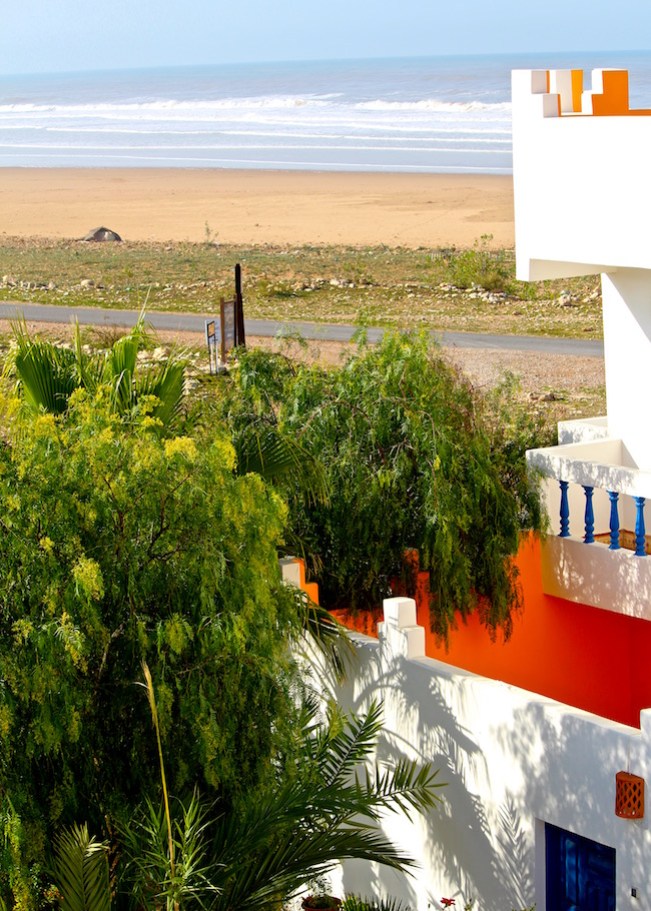
On a February Sunday in 2016 I sat calm, spent on the shore of Sidi Kaouki. Two of my closest friends, Kate and Ritchie, were with me eating salads by the sea. We were aware that our time together was short—a hazard of expat life that bonds people fierce and fast. I had told the school I wouldn’t be returning to Morocco in the fall. When offered another contract, I was tempted to stay longer because leaving the kids, friends, and country would be so hard and no job had opened at home. But I missed my kids and though they were adults, I felt they needed me.
We had completed a writing workshop at the Blue Kaouki hotel in a rural area twenty-five miles south of Essaouria. Jason, a writer and our co-teacher, had led the workshop of faculty members. He and his fiancé often surfed at the quiet beach town, so we stayed at their usual hotel, which had a terrace and sunroom where we could meet shielded from the February wind.
We had left school on Friday and while the ride through the rural countryside was beautiful, my gut churned. A policeman stopped the van and climbed aboard, asking us one-by-one where we were from and where we were going. Satisfied with the driver’s papers and our answers, he waved us on. I checked my phone again to see what was going on, and it seemed a terrorist cell had been discovered and members had been arrested near there a few days earlier. Even so, this was not what upset me. After living in Morocco almost two years I knew the country’s vigilance against terrorism — the teamwork of the people and the police meant eyes and ears were always protectively watching and listening. No, I was worried and felt sick about what was going on at home.
My plan had been to return to the same address of twenty-one years after my time abroad, but circumstances had left my house standing empty for a couple of months. I’d hoped to get a renter until I could move back in late June, but no one was interested in such a short lease. I couldn’t afford to let it set empty until then, and I didn’t want the stress of renting it for a year, leaving me with nowhere to live. Given the upkeep of a large yard and an old house, I wondered if it was time to downsize. After months of praying and discussing with my family, it seemed time to let it go.
In 2014 before I left the US, I read an article written by an expat that said there would be great gains from living overseas. I knew I was meant to go to Morocco, but the article said there would inevitably be losses, too. I never dreamed our family home would be one. Today, almost a year since the house sold, I am thankful and believe God worked out all things for good, but I still sometimes wake from dreams where I’m on my deck with my dog or in the kitchen with my kids, and my heart hurts. A year ago… the heartbreak seemed unbearable.
Ritchie, who is now teaching in Russia
I hated that the huge job and burden of getting the house ready to rent or sell had fallen on my brother-in-law, sister, and daughter—months of fielding phone calls; meeting potential renters/buyers; cleaning; hauling; painting; upgrading; waiting on installers, repairmen and inspectors. A back-breaking and agonizing feat, a sacrifice of precious time–all for which I will be forever grateful and humbled by.
I also hated that I couldn’t say goodbye.
So when Jason sat us down and explained we’d be writing from the part of us called our “Crazy Child,” I felt grateful for release and terrified of what would surface. The last two months I’d cried into my prayer journal—pages of countless question marks and pleas for answers from God. The day before we left for the workshop, I prayed He would strengthen my family over the weekend for the final phase of preparing the house to be sold. I asked for stronger faith for us all from the outcome—whatever would ultimately happen. But as my guilt for being away mounted and grief grew, I felt physically sick.
The Crazy Child is an aspect of your personality that is directly linked to your creative unconscious. It is the place in your body that wants to express things. It may want to tell jokes, to throw rocks, to give a flower to someone, to watch the sunset…
To convulsively weep and throw up simultaneously? I wondered, hoping so, because that was what mine was about to do.
The Crazy Child is also your connection to the past. Everything in your genetic history, your cultural history, your familial history, and your personal history is recorded in your body—in your nervous system. Your Crazy Child has direct access to it all. Everything you have done, and everything that has been done to you, is in its domain…
When the Crazy Child writes, it’s a raw, truthful part of you that reveals itself. It has not been civilized…Your Writer and Editor …are valuable aids to writing. But the Crazy Child—your creative unconscious—is the source.
I had thought the workshop would be good for me. I was thankful for a chance to focus on creating something rather than losing everything.
I knew the “Editor”—the critical voice—all too well. It always spoke in “shoulds” and kept reminding me that I should be home in Tennessee this weekend, though logic told me there was no way I could get there and back from Africa in two days. So when Jason sent us off to write from our Crazy Child—not the Writer who wants to organize or the Editor who wants to polish—I felt relieved. Alone I could cry and cleanse my stomach of everything souring there. There would be time to revise the draft others would see later.
When we reconvened I felt weak but better. The dry heaving had subsided. But then, to my horror, Jason said we would share THIS PIECE…NOW. To reassure us, he read from Bird By Bird written by one of my favorite authors, Anne Lamott, on the value of what she calls “shitty first drafts”:
Now, practically even better news than that of short assignments is the idea ofshitty first drafts. All good writers write them. This is how they end up with good second drafts and terrific third drafts. People tend to look at successful writers who are getting their books published and maybe even doing well financially and think that they sit down at their desks every morning feeling like a million dollars, feeling great about who they are and how much talent they have and what a great story they have to tell; that they take in a few deep breaths, push back their sleeves, roll their necks a few times to get all the cricks out, and dive in, typing fully formed passages as fast as a court reporter. But this is just the fantasy of the uninitiated. I know some very great writers, writers you love who write beautifully and have made a great deal of money, and not one of them sits down routinely feeling wildly enthusiastic and confident. Not one of them writes elegant first drafts. All right, one of them does, but we do not like her very much. We do not think that she has a rich inner life or that God likes her or can even stand her. (Although when I mentioned this to my priest friend Tom, he said you can safely assume you’ve created God in your own image when it turns out that God hates all the same people you do.)
For me and most of the other writers I know, writing is not rapturous. In fact, the only way I can get anything written at all is to write really, really shitty first drafts. The first draft is the child’s draft, where you let it all pour out and then let it romp all over the place, knowing that no one is going to see it and that you can shape it later. You just let this childlike part of you channel whatever voices and visions come through and onto the page. If one of the characters wants to say, “Well, so what, Mr. Poopy Pants?,” you let her. No one is going to see it. If the kid wants to get into really sentimental, weepy, emotional territory, you let him. Just get it all down on paper because there may be something great in those six crazy pages that you would never have gotten to by more rational, grown-up means. There may be something in the very last line of the very last paragraph on page six that you just love, that is so beautiful or wild that you now know what you’re supposed to be writing about, more or less, or in what direction you might go — but there was no way to get to this without first getting through the first five and a half pages.
Normally the “Mr. Poopy Pants” part would have made me laugh, but I just wanted to cry. Again. I felt as I had so many years ago—naked and exposed. My paper was worse than undigested food mixed with stomach acid. Following Anne Lamott’s lead…I told Jason my draft was not only shitty. It was liquid diarrhea. How could I not clean it up? It was sure to smell up the place. As the sharing began I realized I had no other choice but to let it go. To let her go. My Crazy Child would wait her turn, then share like the others.
One-by-one we read. Around the table our crazy kids showed themselves. They were from Canada, France, Australia, The Philippines, England, and the US. Collectively they made us giggle, laugh, nod, sigh, and weep. We asked them questions and repeated back their words—their wisdom, their courage—as their writers took notes. When I finished reading, some were crying and Ally, our guidance counselor and one of the most sensitive souls I’ve ever known, got up, walked over, and hugged me from behind. We all left lighter that day because we carried home something of substance—of ourselves and of each other. Our sharing made us vulnerable, and for that we left stronger.
Yesterday I saw on Pinterest writing prompts my daughter had pinned. She and her brother are doing great, and that makes me happy. Recently I took the online class by Brené Brown, The Wisdom of Story, and have finished the first chapter of the memoir I’ve needed to write, it seems, my whole life. I get up at 5 AM before work and continue after school till I can work no more. Glennon Doyle Melton, Brown’s co-teacher, says we must write from our scars, not our wounds. This morning I reread what I wrote at the workshop a year ago. It was stream-of-consciousness–the gushing flow of multiple losses over many years, allowed to surge when the locks were lifted on the dammed pain. It will be there– in my book—because it covers chapters, decades, of my story.
In some ways I’m where I was a year ago. And not. Then I had no idea I’d end up teaching in The Dominican Republic. I’ve told the school I’ll be moving home this summer to be with my family, though no job has opened there. Whatever happens, I know I’m to continue working on my memoir and that my Father loves and has a plan for this Crazy Child, Gypsy, Writer, and Southern Mom–all me.
*I know many of you have told me you want to write your story, too. I have also found these resources to be helpful:
A wedding. Two unique people become one. A mystery and a marvel. Until recently I’d never attended a January wedding, but starting a new year with a couple committing to share the rest of their lives felt right.
And kind of Disney. Weddings renew hope, reminding us that there is happy-ever-after, not only for the couples, but also for the communities their love creates. Flocked around the lovebirds on an island in the Caribbean were family and friends who’d flown from around the globe to witness, to be…love.
The Magic Kingdom may own ships on which families ride off into the sunset, but they still market their “It’s a Small World” ride as the “Happiest Cruise that Ever Sailed.” I went to Disney World as a kid just after it opened, and, shocker, it was my favourite attraction. Three-hundred papier-mâché dolls traditionally dressed dancing and singing in their native languages a simple song of world peace made my soul sing.
Looking at the guests gathered, I remembered again that it IS a small world. Marcus, the priest who married them and the groom’s lifelong friend, called us The United Nations. They’d gone to high school together when Moises moved from the Dominican Republic to the US, and it turns out Marcus now lives in Louisville, Kentucky, the state in which I was born. In fact, when I met his fiancé at the wedding (they got engaged three days after the wedding at this waterfall) I learned she is from Madisonville, Kentucky –35 miles from Hopkinsville where I grew up.
Maria, the bride, is my coworker. Some of her family and friends flew in from Russia for the celebration. A couple of years ago I’d assisted a coworker, also Russian, in taking student delegates from The American School of Marrakesh to St. Petersburg to the Model United Nations Conference. (I love that in Model UN each student draws a country—not his or her own—to research and represent on global issues. The task is to collaborate with delegates from other countries to find solutions that benefit all.) Of all the European cities I’ve fallen in love with, St. Petersburg is probably the most beautiful–canals like Venice and Amsterdam lined with art, parks, and more palaces than Paris.
Emma, Maria’s longtime friend, came down from New York.
Maria’s sister Skypes in their mom from Russia.
Calise, a friend I met at my table of Santo Domingo friends including one couple now living in Brazil, is a diplomat for the DR in India and Argentina. Her brother, who was abroad, is another close friend of the groom.
Maria was one of the first people I met after moving to the Caribbean. When I needed to see a doctor and couldn’t make an appointment or speak in Spanish to the clinic staff, she went with me and translated. She introduced other coworkers and me to Moises. Gregarious and kind, he took us all to Zona Colonial for salsa and dinner and has grilled for us while on duty and off the best steaks in town. A chef for big destination weddings across the island, he and Maria decided they wanted their day to be relaxed and fun, which it was, with his staff cooking in the kitchen and serving the feast.
Guacamole
The best mojitos imaginable
Coconut water
Traveling to twenty-five countries on four continents has amazed me with the world’s vastness. Travel provides wide, open spaces for beauty and adventure. And sometimes loneliness. I didn’t speak French or Arabic in Morocco and I barely speak Spanish, but I’ve learned to depend on the kindness, the hospitality, of strangers who become friends.
I am most changed–I think we all are– by the people we meet. Friends I’ve met on the road. People at home I’ve loved all my life. I’m no longer a child, but I still believe it’s a small world. That most of us are more alike than different. That God is love and says we must love one another. That peace happens in our world, our country, our hearts through real relationship. Face-to-face, heart-to-heart encounters with people truly change the world…for good.
After a Domincan breakfast of eggs, bacon, sausage, beans and rice, papaya, mofongo we were back on the van following the blue bus above deep into the jungle. It is estimated the Dominican Republic has 1.5 billion USD in marble, most of it mined in the Samana province. When we explored Mina de Marmol I again wished my dad was with me. He’d worked in a rock quarry for years in Kentucky.
From there we headed to Boca Del Diablo, the Mouth of the Devil, a blowhole where the sea churns beneath and sounds like a dragon breathing until it spews water up and out the cliff’s surface above. I was so excited to get this on video that when I heard the ocean churning I took off too fast across an overgrown path and tripped on the jagged stones under the vegetation. Semi-dehydrated, when I was pulled to my feet and looked down upon a 2- inch strip of skin hanging like crepe paper from bloody gashes in my knee I almost fainted. Thankfully Steve and Sana took my camera and got the shots of the cliff below.
Though only my traveling companions spoke English, a kind lady on our van from Ecuador gave me some antibiotic cream and our guide brought a bottle of water from the cooler. Afraid I would vomit or faint, I poured the water over my head and felt better.
In the van as we headed to the beach, I thought about my first instinct after the shock of being bit by the devil’s mouth.
Blindsided by going down, I turned on myself: What are you thinking going on an adventure like this at your age? Living outside the US? This is all a bad idea.
As my friend, Kim, and I have discussed often, when blindsided we feel shocked and vulnerable as I did in an earthquake in Costa Rica or a van wreck in Morocco. The impact of being taken down unexpectedly shakes lose accumulated hurts and hard times bringing us to our knees literally.
Challenges with this move had been churning in me for awhile and, released by my fall, they blew inside my head. Once I could be as kind to myself as others were to me, I was back on track and headed to the next beach.The next day I’d get a stronger antibiotic
but at our next stop beauty would make me forget the pain and I’d plunge into the cleanest, most beautiful waters I’d ever seen. The salt began healing my body at the gorgeous Las Galeras and I was again so grateful for the chance to see all I’ve seen on this island. Here we played in the water and had delicious fish for lunch.
Pina Colada
The last stop of your beach hop was Cano Frio where the Atlantic creates a freshwater swimming area locals love.
While I enjoy solo travel, this weekend reminded me of the importance of friends wherever we live. Together we are stronger and can pull each other up when, far from home, we fall down.
Long before Pinterest prodded us to create virtual vision boards, Instagram insisted we share in-the-moment bliss, and Facebook fostered travel posts of happy places far, far away, I cut out and saved a magazine photo of a couple walking in the surf of the Caribbean Sea. I was single again, sad, but looked forward to a day I’d be that girl, her cocktail dress blowing in the breeze, as she laughed and leaned into her guy’s shoulder, one arm wrapped around his, the other hand holding a champagne flute. I longed to share such a celebratory moment in paradise… one day (sigh)… with The One who was meant to be—whoever, wherever he was.
Though I still wait in hope to meet him, I have learned to cherish the many people with whom THE One, God, has blessed my life. And over the last twenty years, I stopped waiting to be in a romantic relationship to see the world or show it to my children. Money I have spent on traveling with my family, friends, and students strengthened relationships, made priceless memories, and taught us all something. Likewise, I’ve learned to appreciate solo travel which has given me confidence, courage, and peace I never thought possible. A mentor told me years ago that giving ourselves what we need models self-care to our children and is healthier than waiting for someone else to fulfill us. Travel rejuvenates and like a class taken to improve mind, body, or spirit, it’s an investment in personal growth which positively impacts us and those around us. Yet, though I’d traveled from Moscow to Morocco to Malibu and now live in the Caribbean in Santo Domingo, something inside kept saving the fantasy island resort experience for a hoped-for honeymoon. Until recently…
Though Punta Cana is known for love connections– the 2014 season of The Bachelorette was filmed here– and this 5-star mega-complex in The Dominican Republic is popular for weddings, family vacations,
This family reminded me of Florida vacations with Taylor and Cole. I long for those days but in the words of Disney’s Dori, a family favorite, we have to keep swimming.
and bachelorette/bachelor getaways,
the Caribbean haven cradles single women travellers with comfort. For those of us with grown children on their own journeys, going solo can provide rejuvenation and even reinvention as we navigate this new season of life.
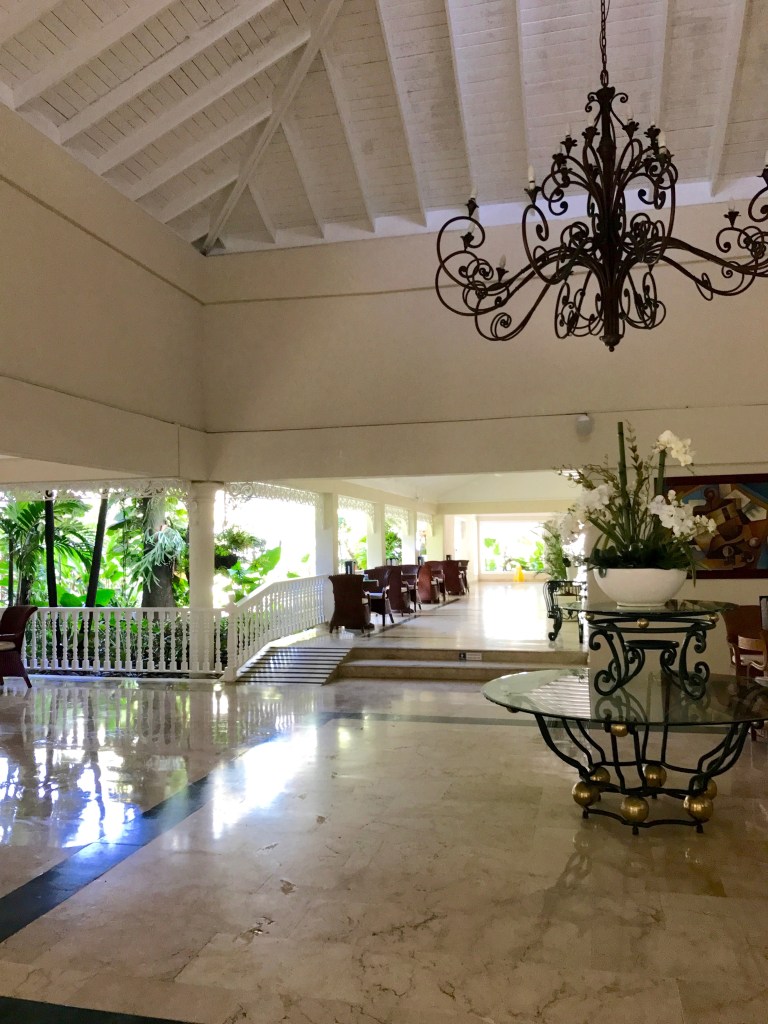
I was impressed by the 85-year history of the Barcelo Group, a family company founded by Simón Barceló in Felanitx (Mallorca, Spain) and later expanded internationally. After scanning The Dominican Republic by helicopter, owners chose Punta Cana–a then deserted stretch of beautiful jungle and beach. Because they bought wide rather than deep as many property owners have since, this resort stretches two kilometres along Bavaro Beach rather than behind a small oceanfront area. The company’s hotel division now has over 100 hotels in 19 countries and its travel division has 685 travel agencies in 22 countries. These figures position it as the third largest hotel chain in Spain, and the forty-second largest in the world.
2) REST AND REVIVE.
Choosing an all-inclusive resort is the best way to rest before and during your stay since everything–where to eat, drink, swim, sunbathe, shop, be entertained, be active, and find transport–is provided. While I enjoy researching and plotting my own travel adventures from restaurants to excursions, planning takes energy and time. For those worn out from home/work responsibilities and constantly making grown up decisions, going with the flow of resorts that offer everything from a bowling alley to a soccer field
to a casino
to live entertainment can be freeing. For those flying into the Punta Cana airport, transfer service to the resort can be arranged as can car rental. Currency exchange is available and stores carry items you may have forgotten, like sunscreen. Upon arrival at reception, get a map to see the lay of the land, and if not interested in the buffet, make reservations for some restaurants which require them and any special services–such as spa or tee times (though you can call from your room to set these up later). I traveled less than three hours from Santo Domingo but was tired and upon checkin rested awhile, then showered before dinner.
Relaxing shower and pampering products provided
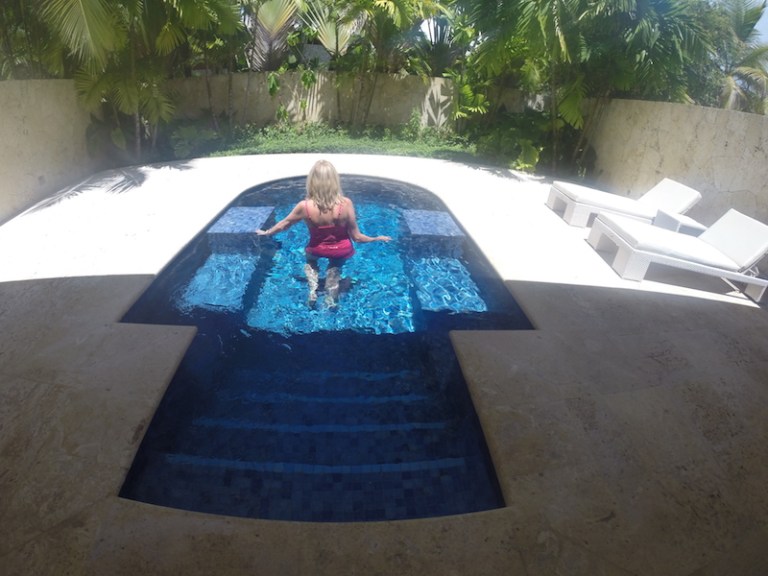
Realize as the New Kid at Camp (seriously, the Barcelo complex feels like an amusement park/pleasure palace for adults), it’s normal to feel excited but also strange not having friends or family there to share the experience. A trip to the spa and Wellness Center with use of the private pool outside thanks to Premium Level (this upgrade also provides free internet and personal service in the Premium Level Lounge which serves food and champagne and early and late check-in/check-out when available),
Photos of me by Patirica Fuentes, Community Manager, Barceló Bávaro Grand Resort
a dip in one of the oceanfront pools,
an iced chocolate cappuccino in the coffee/cigar bar,
or room service, minibar, (courtesy of the Premium Club Suites)
In my room were local rums. Mamajuana is a spicy, peppery legend in the area.
and a movie –whatever you need to unwind–will help you relax, recharge and relish your evening and stay ahead.
3) BREATHE AND DWELL IN POSSIBILITY.
Before dinner at the seafood restaurant where I had lobster on the terrace (the Sante Fe Steak House also has seaside dining), I walked barefoot on sugar sand inhaling the sea air. I breathed…exhaled… under a full harvest moon. What would I reap on this trip? As always, I felt warm knowing those I loved to the moon and back were looking up, too. I thought of Van Morrison, Emily Dickinson, and the Creator of the most gorgeous clouds I’d ever seen. Truly, it was a soothing, surreal, “marvellous night for a moon dance,” a time to “dwell in possibility…the spreading wide (of) my narrow Hands To gather Paradise.”
Though the property is so huge shuttles connect its vast offerings, a solo woman traveler can feel safe walking alone at night.
4) EAT, DRINK, AND BE MERRY.
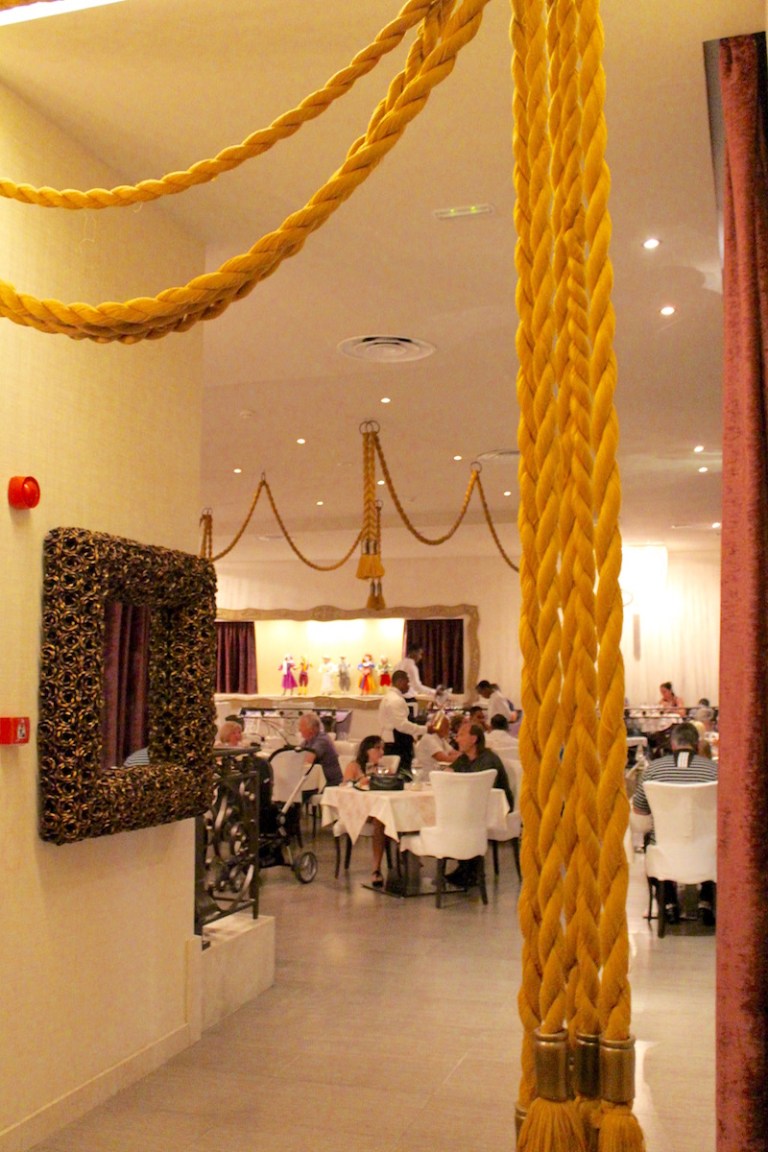
An all-inclusive (see under “Other Important Services”) vacation is NOT where we count calories. Healthy choices are always available, but dieting? No way. And since we first eat with our eyes… the ambience of open air tables set amidst lagoons, lakes, and gardens makes every meal a feast.
I slept later than usual thanks to the blackout curtains, had coffee on my patio where I was visited by a Moorhen, nicknamed the Chicken-foot Coot because its feet aren’t webbed and it steps high like a hen. Rested, I was ready to step out, too, so I headed to the nearest restaurant just around the corner for something I rarely get–a Southern-sized breakfast. The night before PGA golfers (The Dominican Republic is known for the best golfing in the Caribbean) gathered in the foyer bar –champagne, cocktails, beer and bachata music flowing. Now hushed except for the tin, hollow sound of clubs hitting golf balls, the course and sky met as a blue-and-green canvas for a new day.
From Dominican fare to all-you-can-eat buffets to a Buffett-worthy Cheeseburger in Paradise, culinary and beverage choices abound. My finest meal was at the French restaurant recommended by the concierge upon my arrival. I had to book for my second night because it was booked the night I arrived.
Warm Salad with Breaded Camembert and caviar (a first for me).
Snails A’La Bourguignonne
The Chateaubriand was rich and tender. Other choices included Beef Wellington, Pork Loin, Chicken Cordon Blue, and Duck Breast a l’Orange.
Chocolate Fondant
Berries and cream
5) LET YOUR INNER CHILD PLAY.
Remember when you were little and you weren’t afraid to explore, concerned about “getting it right” or impressing others? An all-inclusive where you don’t know a soul allows you to follow Eleanor Roosevelt’s advice: “Do one thing everyday that scares you.” Of course, do what you love. For me, this was dancing bachata on the beach (Romeo Santos had recently done a concert in Punta Cana). Golf, tennis, volleyball, soccer, walking, swimming –do what makes you happy– but leave room to discover a new passion.
Zumba
Maybe learning to like alone time is what you need. Or maybe starting a conversation to make new friends and not just because paddle boats take teamwork.
I loved meeting Patricia who gave me a tour of the property on Saturday and took me out to sea on Sunday. She assists travel bloggers/media influencers, she’s from Spain, loves promoting community and all the Barcelo brand has to offer, and I liked her instantly.
And I finally tried kayaking. It was fun.
So was meeting Harry Lee and Livvy Turner, Brits below who had just arrived. They were in the Caribbean for the first time and were looking forward to ten days of bliss. Harry said they weren’t leaving the property, that he was exhausted by city life. “I am a broken man,” he quipped, “but will return to London with more energy.”
6) LET YOUR INNER CHILD NAP.
Count ships, not sheep, under rustling palm leaves shading you from the sun. And if you can’t sleep, as my mother used to say, rest your eyes and your mind.
In Eat, Pray, Love, Elizabeth Gilbert writes:
“Il bel far niente means ‘the beauty of doing nothing’… [it] has always been a cherished Italian ideal. The beauty of doing nothing is the goal of all your work, the final accomplishment for which you are most highly congratulated. The more exquisitely and delightfully you can do nothing, the higher your life’s achievement. ”
Last spring break I’d planned to practice this skill on The Amalfi Coast. Of course, I planned to write and photograph Positano, but that isn’t work to me. Circumstances prevented that trip, but I’m trying to learn the same lesson in the DR. This weekend was a wonderful teacher.
My favorite–pink and blaring bachata.
7) LOOK BACK IN GRATITUDE.
Recall happy times in the past with thanksgiving. If I’ve learned one thing from many Dominicans it is to laugh and sing more.
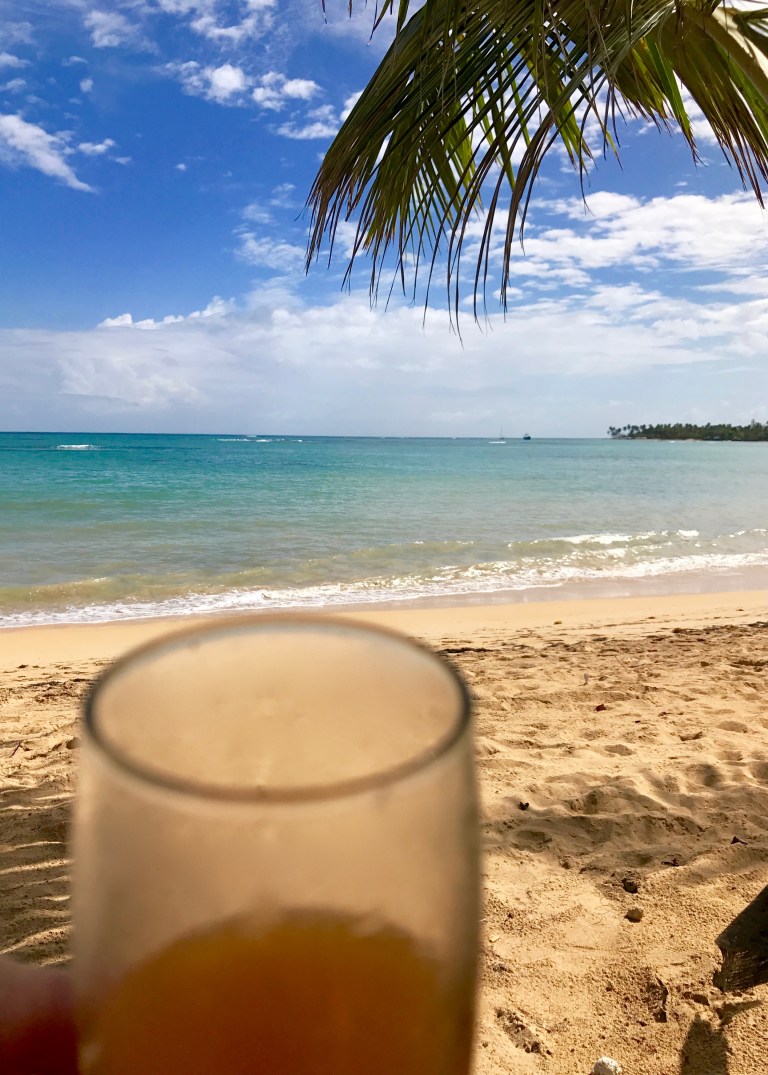
Too often we’re too tired to remember what day it is, much less yesterday or yesteryear. As has happened a lot over the last two years of living abroad memories of family flood me. In Punta Cana I remembered other beach vacations with women who have strongly influenced my life. The summer in Hawaii with my mom, sister, cousin, and aunt. Another summer in Florida with Mom and her mother, Mama Sargeant–single women for many years like me. I toasted to them with a Pina Colada, the drink my grandmother enjoyed when she became ill and mom moved in with her until she passed. I thought of a month earlier when my daughter, Taylor, and I enjoyed another DR beach together.
8) LOOK FORWARD IN HOPE.
As gentle waves lap the shore the clear, calm waters of the Caribbean invite reflection. Remembering happy times, even hard times, reminds us of all we’ve overcome to get to this place which strengthens us to face, even greet what lies ahead.
Scan the horizon knowing that good is coming. In studying Spanish I realized this week the roots for esperanza, hope, and esperar, to wait or to expect, are the same. Faith says to wait, to expect with hope.
On this lake is the Barcelo chapel where some couples marry.
And on this pier, a group of friends waited for the bride and groom.
What are you waiting for? Some things we can make happen. Others we can’t, so we must trust, wait, and watch. Traveling solo helps us figure out what we want and how, if in our power, to get it. What to hold onto. What to let go of. The beauty of this gorgeous globe gives us peace in knowing the One who created it can work all things together for good.
9) SEIZE THE DAY AS THE BEST SOUVENIR.
We must live in the moment. I agree we can take so many photos trying to capture special times that they truly escape us. Too much staging can kill just being, breathing the experience. And yes, people may laugh at your selfies, but deep down most of us want to remember times we recognize as special pieces of eternity. Even if you don’t typically like to have your photo taken, you will want to remember that you were once in a beautiful place and felt more beautiful for it. I promise. Just as a mom says if the house were on fire and all people and pets were out safely she’d grab baby photos first, one day you’ll want to see yourself in a Caribbean paradise where you grew, changed–even use the photos as your screen saver–so you don’t forget how important it was–it is–to get away and enjoy gifts of beauty and adventure you’ve been given.
While in Punta Cana I read an article in More magazine called, When Looks Fade: An Exercise in Perspective by Christine Lennon who interviewed “The Professionally Beautiful,” asking them how to age with grace. Molly Sims, author of The Everyday Supermodel said:
“It’s funny how I used to look at a picture when it was taken and think, Ugh, I look awful. You look at that same picture five years later, and you think, Dang. I looked pretty good.”
A friend in her 40s recently had professional photos taken to remember this time in her life. My mom did the same in her mid-30s. I get it. Even if you shy from the camera, the best souvenirs of any vacation are photos which capture living -in- the- now forever. At a Caribbean resort photo opps are everywhere and you’ll see many taking advantage of it. Don’t be shy. Help a solo traveling sister out. Ask if she’d like you to take her picture and ask her to take yours. Hotel staff will kindly oblige as well.
Whatever your age or style–girly girl, Bohemian Babe, or mermaid, wear something–maybe a new frock found in shops on the complex– that makes you smile. Though I brought a tropical dress with me–a TJMAXX special–I was thrilled to see new styles of two brands I fell in love with in Spain (Mele Beach in Tarife and Desigual in Vigo) sold at the Barcelo Punta Cana complex.
The beach is your runway. Get creative. Take the plunge. You’ll be glad you did.
10) TAKE A PEACE OF PARADISE HOME WITH YOU.
Peace. Going solo to a Caribbean resort will convince you of what research shows. Though too few people take enough time off, those who do vacation return rejuvenated and more productive. No matter the age. For some of us, the prime time to go solo seems to be when we are trying to survive, even thrive after the nest empties. We are “tweeners”and if we can’t take a gap year, a gap week works, too. Soon–assuming we stay in good health–we may be needed to care for parents and grandchildren. Doing all we can to stay fit–physically, mentally, spiritually–is vital for the ones we love.
We are as young as we feel. I loved seeing women my mom’s age doing Zumba in their bathing suits on the beach. And about those photos and the freedom on your face they will reflect…
Christie Brinkley, 62 year-old author of Timeless Beauty and former Sports Illustrated swimsuit model said, “Aging needs a huge rebranding campaign. People still think of 60 and picture a granny with a shawl and bun. We need to stop lying about our ages. Go ahead and say your number; then you’ll reshape other people’s images of that number.”
Likewise, when people ask in disbelief, You traveled to the Caribbean alone? say, Yes and smile. They may need to be freed, too.
Special thanks to Barceló Bávaro Grand Resort for an amazing experience. As always, the opinions here are my own.
I was excited when my friends, Sana and Steve, invited me to join. Though newlyweds, their kindness and inclusiveness from the day we met blessed Taylor and me. Trusting them as history teachers and adventurers, I did no research but quickly scanned a few photos online and took off. As I’d been thrilled by Venice last January, I wanted Santo Domingo to share some of its secrets as well. I wanted to be surprised. I needed to feel wonder. For awhile I hadn’t had the energy or desire to explore, but last week I’d begin feeling like myself again.
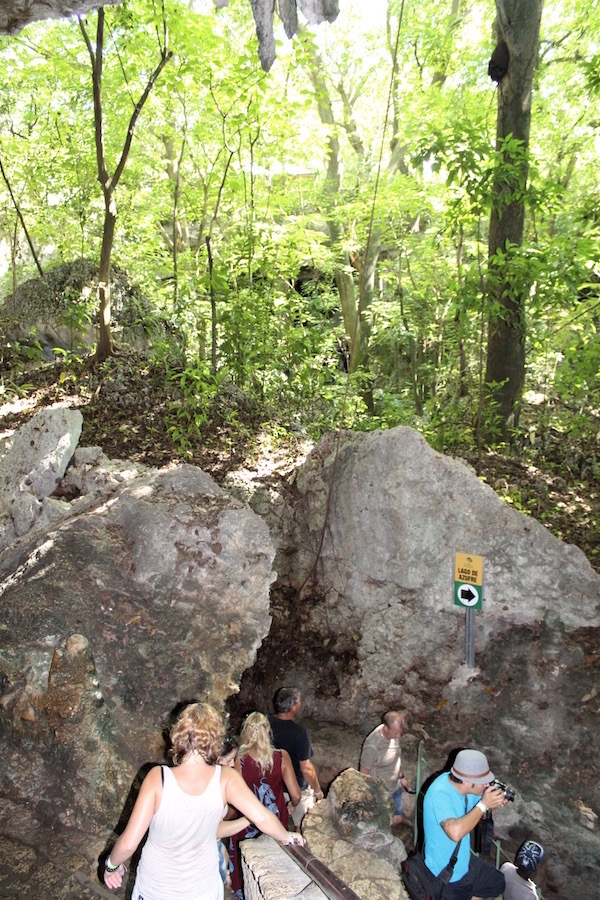
Located just outside the city, Los Tres Ojos (The Three Eyes) costs a mere 100 Pesos/$2 and is open until 5:30 (though ticket sales end around 4:15).
As I journeyed into the dark bowels of the limestone labyrinth leading to underground lagoons, thoughts of spiders made me flinch at water drops from stalactites above. What other creatures might swim and slither within?
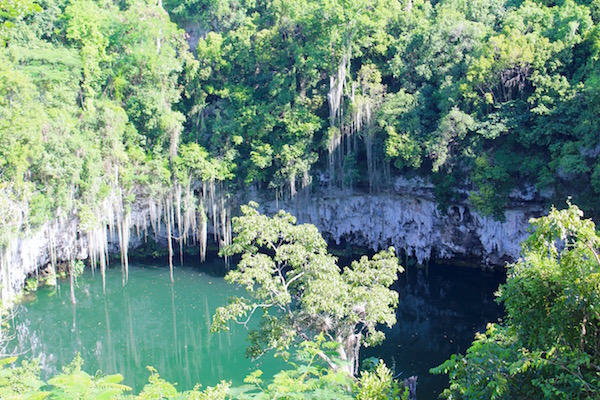
The three underground eyes are Lago de Azufre (Lake of Sulfer) discovered in 1916 , La Nevera (Known as “The Fridge” for its icy cold water) and El Lago de las Damas (“The Lake of the Ladies”) where Taino women–first inhabitants of the island of Hispaniola (now Haiti and the DR) — bathed their children.
The second lake was darker than I’d hoped, and Steve and I joked it was the stuff of the Sci-Fi Channel. I remembered a movie about a mutant shark grabbing a victim gazing into an underground river, so though I wanted to take the boat into even darker depths, I was nervous. Normally I’d take photos with flash, but as we crossed the water I was afraid of arousing bats hidden in holes overhead. My trypophobia was kicking in and I remembered, Katherine, my role model for adventure in The English Patient, had survived desert storms and a war but died in a cave.
On the other side, I crept off the boat, peering down into the dark at the slippery rock beneath my feet. Determined not to sink into the river we’d just crossed, I carefully groped my way around a corner of the cavern. Then, as in every miraculous moment of my life, I looked up and all changed.
My eyes filled with light. I hadn’t read that here was hidden the fourth lake–discovered after the park was named for the other three. But unlike the others, this lake opened fully to the sun. To the sky. To the heavens.
My eyes filled with wonder and recognition as another heart’s desire was fulfilled. As I’d dreamt as a girl of exotic Arabian gardens, then saw them come to life in Morocco, I stepped into another secret place I cherished as a child. I’d watched Tarzan movies my whole life–loving most the black and white Sunday morning Johnny Weissmuller films. But here in living technicolor, realtime, were vines hanging like party streamers beckoning Jane to swing. Turns out, this lake was a location for Tarzan films and Jurassic Park. Memories of dying Katherine vanished. Instead I was strong Kate on Lost and smiled remembering my kids’ groans as I’d drag them around Radnor Lake and tell them to pretend we were on the tv series island scouting for treasure. This island, too– just outside my new city– was mysterious, unearthly, ancient. And alive.
We boarded the boat, left that piece of paradise, and climbed up, then down to the third eye–the most most gorgeous blue water dappled with sunlight. On a walk around the perimeter of the park, I marvelled at this tree and its green bean pods fit for a giant.
The fourth lake, Zaramaguyones, was beautiful from above. But somehow, discovering it on the other side of a darkness and fear made it much more breathtaking.
For all my déjà vu movie moments, the expedition reminded me most of a cave of my childhood and its metaphor guiding my second-ever blogpost written so many years ago. It calls me back to my main mission for writing.
When I was a little girl in Kentucky, the Mother of All Field Trips was going to Mammoth Cave. While I was told not to fear the Natural Wonder, I wasn’t all that excited about going deep into the black unknown, feeling my way down damp, winding paths… The tour guide seemed so calm. She had a light to guide us but no map. She had obviously been in that cave before—many times–and was so familiar with it she could have led us through that vast cavern even if the batteries in her flashlight died.
The only good I can make of getting older is that I’ve lived long enough to have gone into some terrible darkness but emerged again into the light…
Though I have survived great losses, I rarely emerged from the black by way of a blowtorch or floodlight. God usually just gave me a candle—one that flickered—and He whispered He wouldn’t let go of my hand even if the flame went out. I still grope but know He’s there. Even if I can’t feel his fingers interlocked with mine. Even if I can’t feel his hand at all and seem to wander in the dark for days…or weeks….or years. I write to share my cave experiences—those I’ve emerged from blinking in the light as well as those I’m still mining through—looking for something of value as I wait and work and wait for release.
The last few weeks I’m often felt confused. Disoriented. Exhausted. I’ve had health issues and struggled at times to embrace all the changes that have flooded my life this year. Selling the home we loved, then transitioning from Marrakesh to Nashville to here has been fraught with questions about where I’ll ultimately put down roots again. Taylor moved back to Nashville and I couldn’t be happier for her as she goes after the life she wants there. As Paulo Coelho said, “Love never keeps a person from pursuing his or her destiny.” We agreed if living abroad wasn’t right for her–as it isn’t for many people–she could be proud of herself for taking this opportunity and return with no regrets. Though I’d hoped we’d have more time together, I’m so thankful for what we shared while she was here. Letting go again is so hard as all parents know no matter how many times the nest empties, but she and Cole are both in really good places and that soothes my soul. In a week he flies to Washington, DC to start his new job in Knoxville–something he’s waited a long time for. I love and miss them both madly.
So in this silent apartment I’ve been spending a lot of time lately with old friends– like Elizabeth Gilbert –who comforted me with these lines from Eat, Pray, Love:
In the end, I’ve come to believe in something I call ‘The Physics of the Quest.’ A force in nature governed by laws as real as the laws of gravity. The rule of Quest Physics goes something like this: If you’re brave enough to leave behind everything familiar and comforting, which can be anything from your house to bitter, old resentments, and set out on a truth-seeking journey, either externally or internally, and if you are truly willing to regard everything that happens to you on that journey as a clue and if you accept everyone you meet along the way as a teacher and if you are prepared, most of all, to face and forgive some very difficult realities about yourself, then the truth will not be withheld from you.
As for this new relationship with the DR, I cling to the Message version of Matthew 6:22-23: “Your eyes are windows into your body. If you open your eyes wide in wonder and belief, your body fills up with light.” I’ve experienced beauty, adventure, and relationship here. And caves. Big ones. Beyond my two human eyes is a third one of faith–the door to all things bright and beautiful. I remain thankful for the One who holds, now and always, my family, future, hand, and heart.
The third stop on my November beach hop along the Moroccan Atlantic Coast was Paradis Plage Surf and Spa Resort. Owners take pride in being the first hotel in Morocco to combine yoga and surfing—a dynamic duo since yoga prepares and repairs the body after surfing. The property invites guests to ride waves, climb camels, or salute the sun as it rises and sets. Here couples, families, friends, and solo travelers enjoy over 100 suites with terraces or balconies opening to pool or sea. Recreation varies from four area golf courses and an outdoor cinema. Located 30 minutes from Agadir and 50 minutes from an international airport connecting to European capitals via 3-hour flights, the resort is where westerners love to play.
Started by Kabbage Abbes, one of the first investors in Agadir hotels, who teamed with Francois Payot, head of Rip Curl Europe, the resort is a work of art run by Abbes’ daughter, Naima, and her husband, Vincent. Furnishings were created by locals and the gorgeous green spaces and gardens are by Spanish landscaper, Sergio Castaneda Beltran.
Photo by Paradis Plage
Excited to learn more about surfing and to practice yoga, I was shown to a gorgeous oceanfront suite. At the Surf House beach bar while sipping my Flag (local beer) and waiting for a Mexican burger (rare in this region), I saw horses and camels waiting patiently on the sand while cats lounged in the sun. Later, everyone returned for the golden orange sunset.
Simo, instructor here and in video above, is from Rabat. He has taught in Hawaii and on the US East Coast. He guarantees by the end of the first lesson every student will be up on their boards.
In partnership with Rip Curl, legendary Australian brand, Tarik Wahbi, surf pro from Tétouan, is ranked one of Morocco’s Top Ten surfers. Manager of the surf program, he leads a team of gregarious guys who hook up guests with equipment, instruction, and guides to the best waves.
Photo by Pardis Plage
Photo by Paradis Plage
Paradis Plage Surf and Spa Resort nurtures total wellness that fits the unique needs of each guest. Surf and Yoga packages are available for two or five days. Surf School Packages are available for 5 days—2 sessions per day.
Yoga and Spa packages range from two days (daily yoga course, a sensory hammam, and a massage) to five days (yoga course, two hammams, one body scrub, and two massages).
The resort shares with clients the secrets of Moroccan women’s beauty. All cosmetics are 100% natural Taroudant Argan oil, essential oils from Marrakech gardens, pebbles from Imi Ouaddar’s beach, facial treatments using Sous Massa prickly pip, Taliouine saffron or roses of Dades Valley.
Traditional Hammams consist of a black soap scrub, Atlas ghassoul wrap, Atlantic Coast seaweed wrap, Imouzzer honey, and spice scrub. Sensory Hammams fuse fragrances of in orange blossom and eucalyptus to relax and rejuvenate. Managing massages and other spa services is Marie France Riera.
Important Tip: Schedule spa services, especially massages, and yoga classes before you arrive or at check-in because appointments and classes fill fast.
Photo by Paradis PlagePhoto by Paradis Plage
Yoga group classes, the highlight of my getaway, are offered three times daily:
8-9:15 Sunrise Yoga (for all levels)—breathing, flexibility, strength, muscle toning, body opening
11-12:15 Easy Yoga (all levels but especially great for beginners) Asanas postures and poses; precision of body alignment, rhythm, balance
5:30-7 Sunset Yoga (all levels)– detoxification, relaxing based on Vinyasa flow systems
Also available are classes in Yin Yoga Therapy (gentle practice using blocks, pillows, restorative and relaxing to relieve tension in muscles and joints, relax spine and pelvis), Aerial Yoga (hammock used for suspension), Prenatal, Power Flow (ultimate workout for athletes), and 108 Greetings. Custom sessions can be arranged by Karim Fadali.
Photo by Paradis Plage
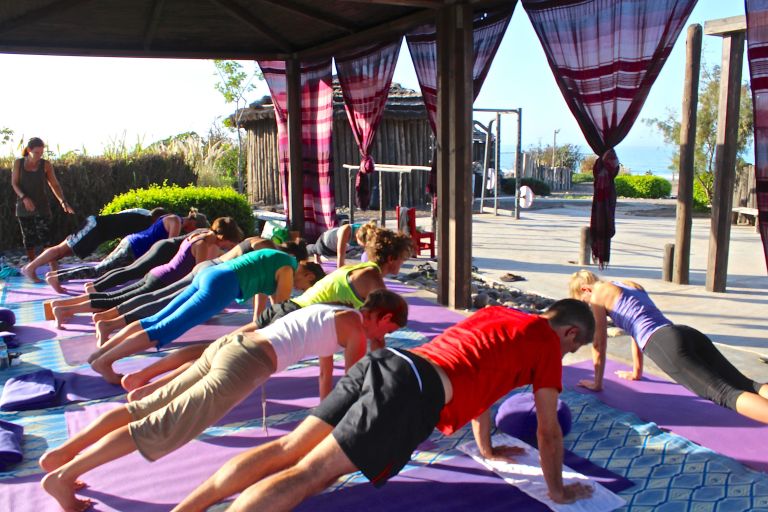
Classes are typically held in the Yoga Shala which consists of two beach studios connected by a lotus pond and facing the sea. Groups may rent the space for private retreats as they did during my stay so guests met in an open air space (see below). Sara, our excellent German instructor, lives in Cairo. Like the best teachers, she is creative, kind, soulful, and a learner herself. She was excited about taking her first surf lesson after our yoga class. My classmates were European as well– some there with partners and others solo. We “sent love to the flies”–pests in the Taghazout region at times– but packing insect repellent might also be a good idea. The small community made it possible to meet other guests in classes and connect with them at the poolside buffets or bars later.
Photo by Paradis Plage
I left feeling refreshed and restored by the beauty of nature and yoga. I loved seeing smiles on surfers’ faces when they did what we all must do to navigate and enjoy life– conquer fear, be flexible and strong, and stand tall as we ride the waves.
Thanks to Paradis Plage for a restful retreat. As always, the opinions are my own.
Recently I stayed at 5-star Sofitel Agadir Thalassa Sea & Spa, just named continental winner of “Luxury Wedding Destination in Africa” by the 2015 Luxury Hotel Awards. My time there was perfection. Though I endorse travel for all, I especially encourage single women waiting for a prince to live happily-after-after to find your bliss now at places that will make your dreams come true. At the premier hotel on beautiful Agadir Bay you don’t have to be on a honeymoon to be pampered like a new bride. In fact, any lady here will be given princess treatment.
When I moved to Marrakech to write, teach English, and travel, I began asking students where their families stay when vacationing. The answer was always the same.
In Paris? Sofitel. London? Sofitel. Rome? Sofitel. Morocco? Sofitel.
Such big brand loyalty (120 hotels on five continents in 40 countries) in the age of hip default to indie companies got my attention. But then again, I’ve always appreciated timeless, classic quality.
The French company committed to total well-being first opened its doors in Strasbourg in 1964. Dedicated to superior service infused with the celebration of art de vivre, each hotel provides cultural experiences from not only France but also each host country in which it is located. Showcasing the best artwork, literature, music, fashion, architecture, gardens, fitness, wines and foods, the hotel beckons guests to experience the sweet life layer by delicious layer. Like bees burrowing gently into the rose— velvet petal by velvet petal—drinking nectar that will become honey in the hive, guests enter space after space of palpable beauty in interactions that feed the soul. Sofitel Agadir Thalassa Sea & Spa stimulates every sense—from plush decor to soothing sounds of fountains and sea to a signature scent, Jatamansi, found only in the Himalayas. Jatamansi, also known as “nard” smells of citrus, ylang ylang and mountains and has so many medicinal powers it is considered sacred in some countries. I left filled, relaxed, energized, healed.
But beyond all these offerings, what makes the Sofitel the Sofitel is the people who work here. From the moment I walked through the doors everyone–from doorman to gardener to manager — greeted me by name. I arrived feeling ill–a situation that could have been a nightmare when traveling alone–but I quickly learned I couldn’t have been in better hands. The staff offered to get me medicine and kindly brought me treats to feel better–Chamomile tea, sweets and fruit, two dozen roses. I am forever grateful for their professional, superior service. Rightfully called, the So Staff is the best in the business.
The new Sofitel Agadir Thalassa Sea & Spa greets guests with a 100 meter long Andalusian pond and 2,000 rose bushes.
Photo by Sofitel
I was welcomed at the door of La Maison Arabe, the reception area in a traditional riad with contemporary black and white design, and served mint tea and Moroccan cookies while the staff checked me in.
Photo by Sofitel
Designer Didier Rey said of the collaboration of building this modern classic, “We had some great interaction with Moroccan artisans. Here I find the pleasure of working in simplicity as it was 20 years ago in France.”
In the gallery on display were thirty works by Younes Fizazi in a collection called “Moroccans Landscapes, Richness and Diversity.” Shots of the Atlas Mountains and Merzouga desert allowed me to relive great trips taken last fall and spring, but having just arrived from the surf town of Taghazout , I especially loved this photograph.
I was excited to see the pool and beach areas next. So Gorgeous.
The spacious suite was sumptuous, and I was especially thrilled with my three favorite elements — the terrace, bed, and bathtub (something I miss most in my Marrakech apartment). This one offered the best of both worlds–a soak with a view–so first on my agenda was a bubble bath followed by a massage.
Prestige Suite Photo by Sofitel
View of pool and ocean from outdoor lounge
Photo by Sofitel
My only complaint was the Sofitel MyBed which abducted me –a custom made mattress, featherbed, down duvet, and sleek, soft sheets. After my massage, I took a nap and slept for hours. 🙂
Hind has magic hands. I swear.
“Evasion et beaute Berbere” (Berber Escape and Beauty) treats the skin to Argan, prickly pear cactus, orange blossom water, rose water and honey. After treatments one can lounge overlooking Agadir Bay and sip herb or fruit drinks. Photo by Sofitel
Les Palais du Jardin, the gourmet restaurant where Chef Fatima cooks Moroccan cuisine fusing traditional and modern flavors. Photo by Sofitel
At L’Amane Bar fresh fruit smoothies, classic cocktails, and a jazz duo can be enjoyed every night from 7:30 PM.
Day 2 I rose early feeling great and ready for breakfast on the terrace of L’Atlantique.
After breakfast I went to play in the next door neighbor’s backyard–Sofitel Agadir Royal Bay, recipient of “Luxury Beach Resort in Morocco” by the 2015 Luxury Hotel Awards. Of its many distinctions, Sofitel Morocco was selected to host the first Kids’ Villa offering educational programs, pastry classes, belly dance, gardening workshops, swimming, aerobics, and a library for children. The honor was bestowed because The Little Prince was born in the imagination of Antoine de Saint Exupery in Morocco.
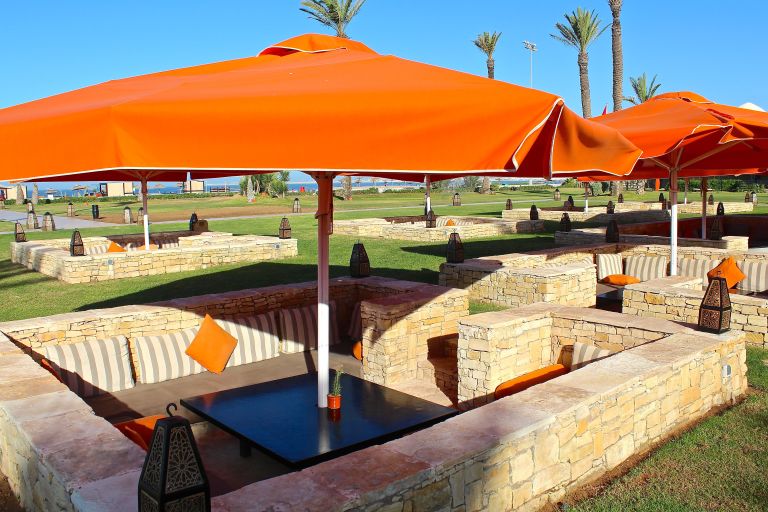
Opened in 2004, the Sofitel Agadir Royal Bay Resort was the first hotel brand in Agadir. A contemporary Kasbah, its colors are warm copper, wood, and orange, the emblem of the Souss Valley symbolic of fire representing Berber hospitality.
Six duplex villas with infinity pools overlook the ocean.
The So Lounge is the center of nightlife in Agadir and a great place for the Birthday Girl.
A winter holiday destination that offers sun- by- day and fire- by- night, Sofitel invites reflecting on the past year and dreaming of the one to come. Photo by Sofitel
Agadir, “Pearl of the South,” is a three-hour flight from major European cities. It’s where Europe migrates in winter to enjoy 300 days of sunshine each year and the Sofitel experience– timeless as Coco Chanel, delicious as Crème brûlée, and exotic as only Morocco.
Special thanks to Sofitel and Soukaina Ghallab for an unforgettable experience. As always, the opinions are my own.
Never miss a post: travel inspiration, destination itineraries, tips, trends, and tales from the road here. Be the first to hear about online and destination travel writing retreats and workshops.













 an iced chocolate cappuccino in the coffee/cigar bar,




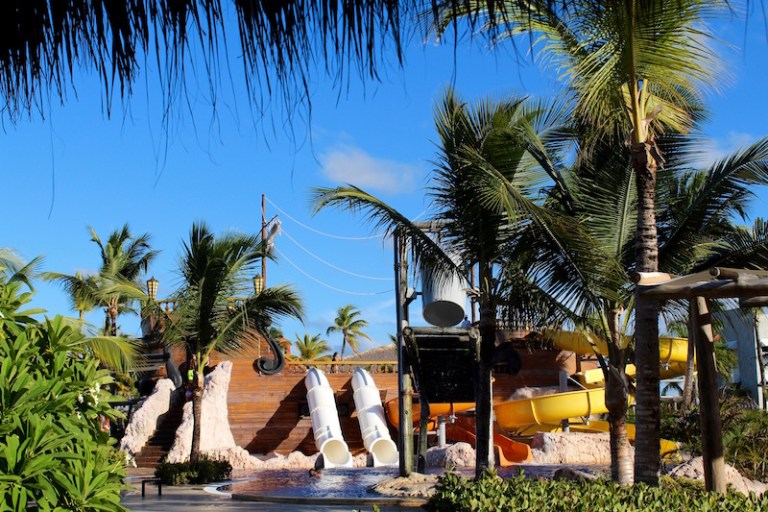








 After breakfast I went to play in the next door neighbor’s backyard–